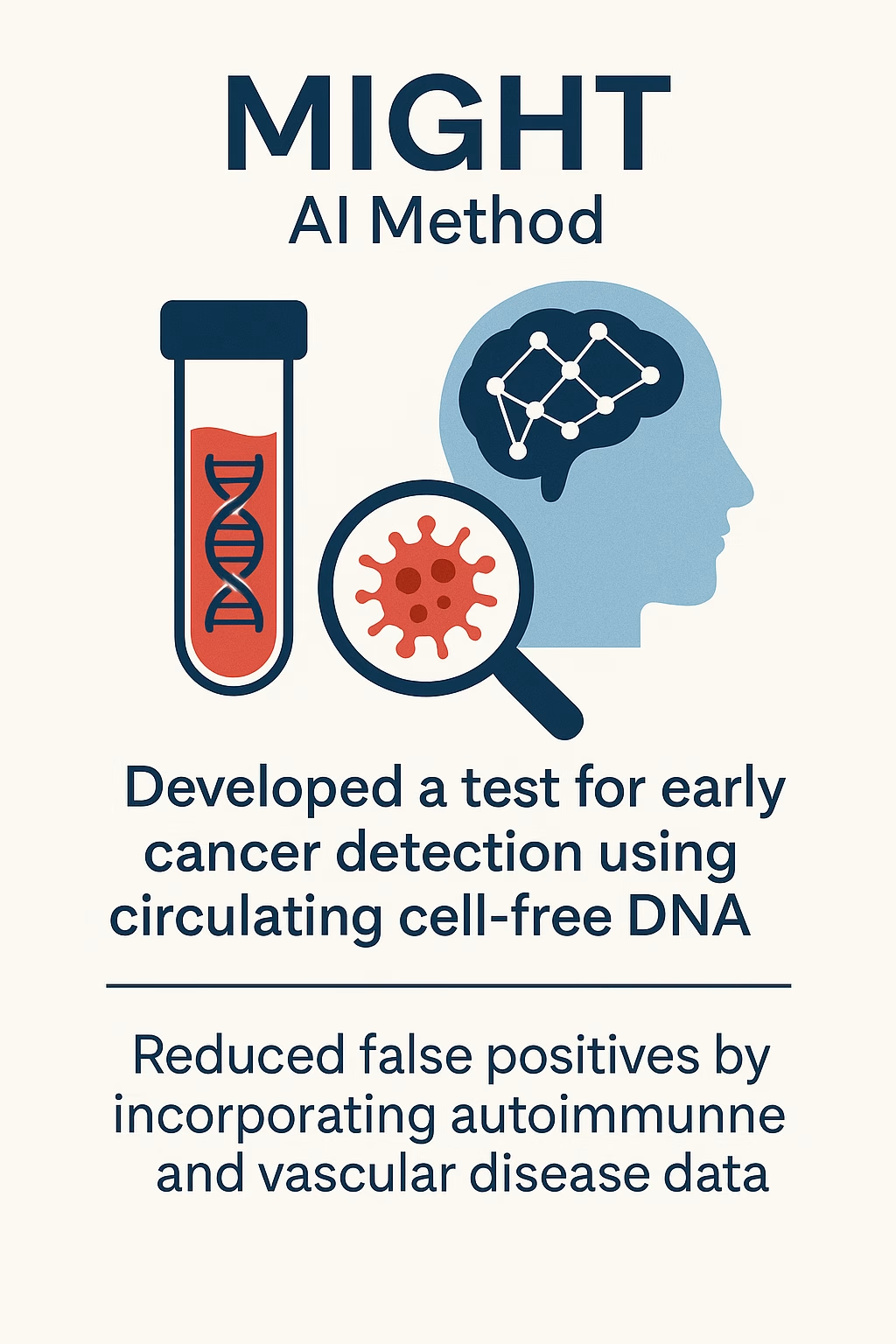
Researchers applied MIGHT to liquid biopsy data, focusing on ccfDNA fragmentation patterns (e.g., fragment lengths, positions, and end motifs) to determine which features reliably indicate cancer:
- In a study of 1,000 individuals (352 with advanced cancer, 648 without), MIGHT evaluated 44 distinct biological feature sets.
- Features tied to aneuploidy—abnormal chromosome counts—emerged as the top predictors.
- MIGHT achieved 72% sensitivity (detecting cancer cases) and 98% specificity (correctly identifying non-cancer individuals). Inside Precision Medicine+10Johns Hopkins Medicine+10JScholarship+10BIOENGINEER.ORG+1
Challenge: False Positives Linked to Inflammation
A companion study discovered that certain ccfDNA fragmentation signatures thought unique to cancer were also present in individuals with autoimmune (e.g., lupus, scleroderma, dermatomyositis) and vascular diseases (e.g., venous thromboembolism). These shared signatures correlated strongly with inflammatory biomarkers, making it difficult to distinguish cancer from non-cancer inflammation. Clinical Lab Products+7Johns Hopkins Medicine+7HPN Online+7
How MIGHT Addresses This
To tackle the issue of inflammation-driven false positives:
- The research team expanded MIGHT’s training data to include ccfDNA and inflammation profiles from patients with autoimmune and vascular diseases, sourced through collaborations at Johns Hopkins and partner institutions. LifeScienceHistory.com+12Johns Hopkins Medicine+12Complete AI Training+12
- This enhanced training improved MIGHT’s specificity—the ability to distinguish cancer from inflammatory disorders—while preserving high sensitivity. False positives were significantly reduced, although not eliminated entirely. Johns Hopkins Medicine+2BIOENGINEER.ORG+2
Summary Table: MIGHT at a Glance
| Aspect | Details |
|---|---|
| Goal | Enable trustworthy AI-driven diagnostics by quantifying uncertainty and controlling error types. |
| Method | Uses ensemble decision trees and data calibration to handle high-dimensional, small-sample biomedical datasets. |
| Performance | 72% sensitivity and 98% specificity for cancer using ccfDNA aneuploidy features. |
| Challenge | Fragmentation signals overlap with autoimmune/vascular disease signatures due to inflammation. |
| Solution | Augmented training with inflammatory disease data to reduce false positives. |
| Outcome | Improved diagnostic precision, paving the way for accurate, transparent AI diagnostics. |
Broader Implications
- Clinical Integration: Recognizes and mitigates AI-specific barriers like overconfidence, lack of uncertainty measures, irreproducibility, and the need for probabilistic, interpretable outputs. LifeScienceHistory.com+9Johns Hopkins Medicine+9PubMed+9Complete AI TrainingClinical Lab Products+1
- Generalizability: MIGHT’s design suits other fields dealing with complex variable structures and limited data (e.g., astronomy, zoology). BIOENGINEER.ORG+3Johns Hopkins Medicine+3Complete AI Training+3
- Next Steps: Both MIGHT and its extended version CoMIGHT are available at treeple.ai for broader research use and exploratory validation.HPN Online+10Johns Hopkins Medicine+10Complete AI Training+10
Final Thoughts
MIGHT represents a pivotal advance in clinical AI—combining rigorous statistical foundations with real-world adaptability. By acknowledging and compensating for biomarker overlap across disease states, it provides reliable, interpretable diagnostic insights. This strategy aligns AI innovation with the trust demands of medical professionals and patients alike.